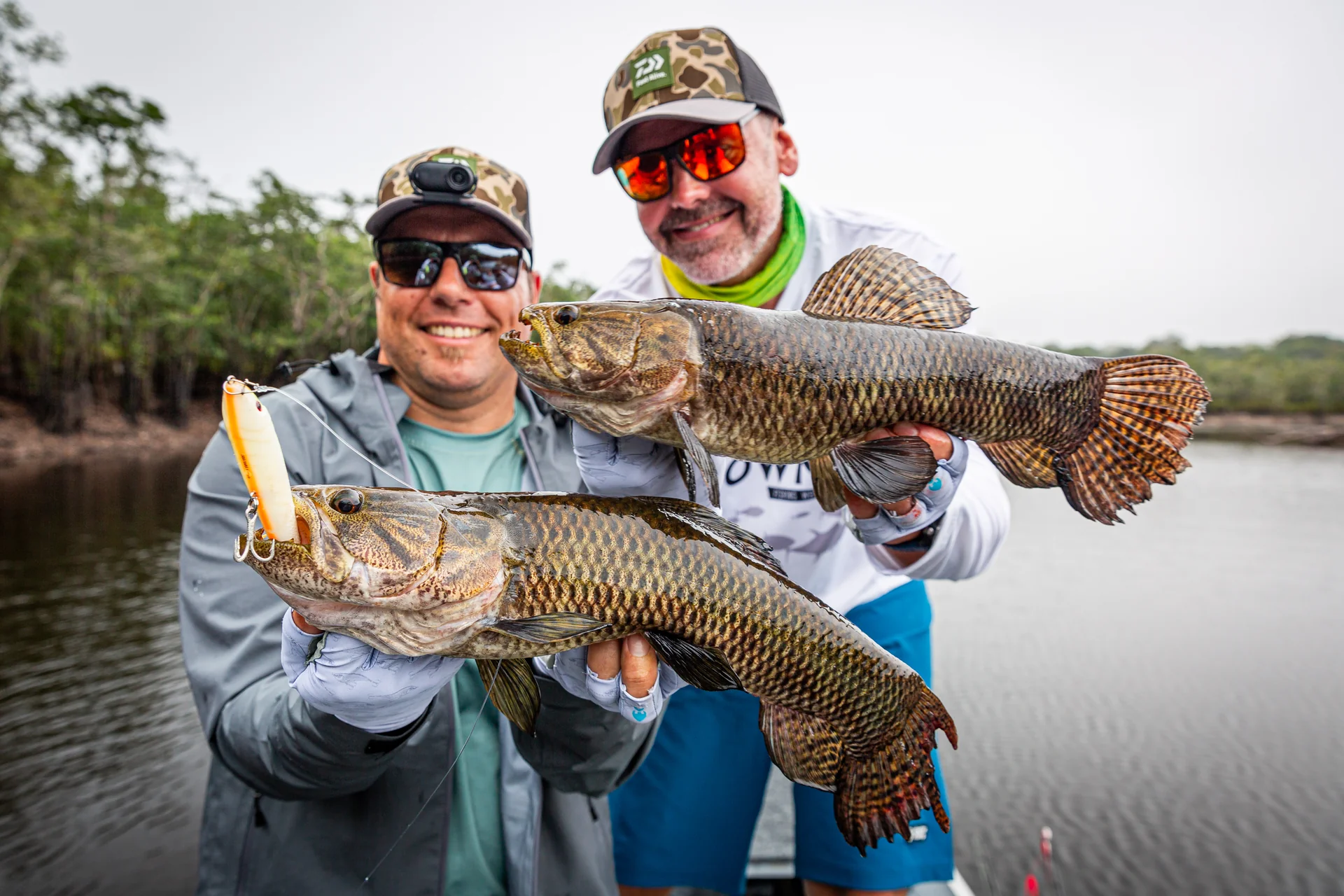
BRAZIL – RIO JURUBAXI: HUNTING MONSTER PEACOCKS ON A CLOSED RIVER
Brazil and peacock bass belong together like thunder and lightning. For generations, the Amazon has drawn legions of anglers chasing one species above all: the peacock bass, unmistakable for the large tail spot that recalls the eye of a peacock feather. But there is a difference between “peacock bass fishing” and what awaits you on the Rio Jurubaxi. The biggest fish grow where they are left alone most consistently – and hardly any water in the entire Amazon basin is protected as strictly as this tributary of the Rio Negro. The Jurubaxi lies on the indigenous land of Téa-Jurubaxi, sport fishing is limited to twelve weeks a year, access is controlled around the clock, and these 270 river kilometres may be fished exclusively by our partner and his ships. Anyone who travels here has one goal: a Cichla temensis beyond the 80-centimetre and 20-pound mark. Welcome to the Jurubaxi!
OUR TOP 10 REASONS FOR YOUR FISHING TRIP TO THE RIO JURUBAXI
- Exclusive fishing rights: 270 river kilometres on which nobody fishes except our boats
- Closed indigenous territory – access to the Jurubaxi is controlled and monitored around the clock
- Sport fishing permitted only twelve weeks a year: minimal fishing pressure, maximum fish quality
- A maximum of 10 anglers per week on the entire river
- One of the best trophy rivers for Cichla temensis worldwide – river record: 90 cm and 27 lb
- On our October 2024 tour, every participant caught at least one peacock over 80 cm
- Strict catch & release, documented by an indigenous monitor who is on board in addition to the guide
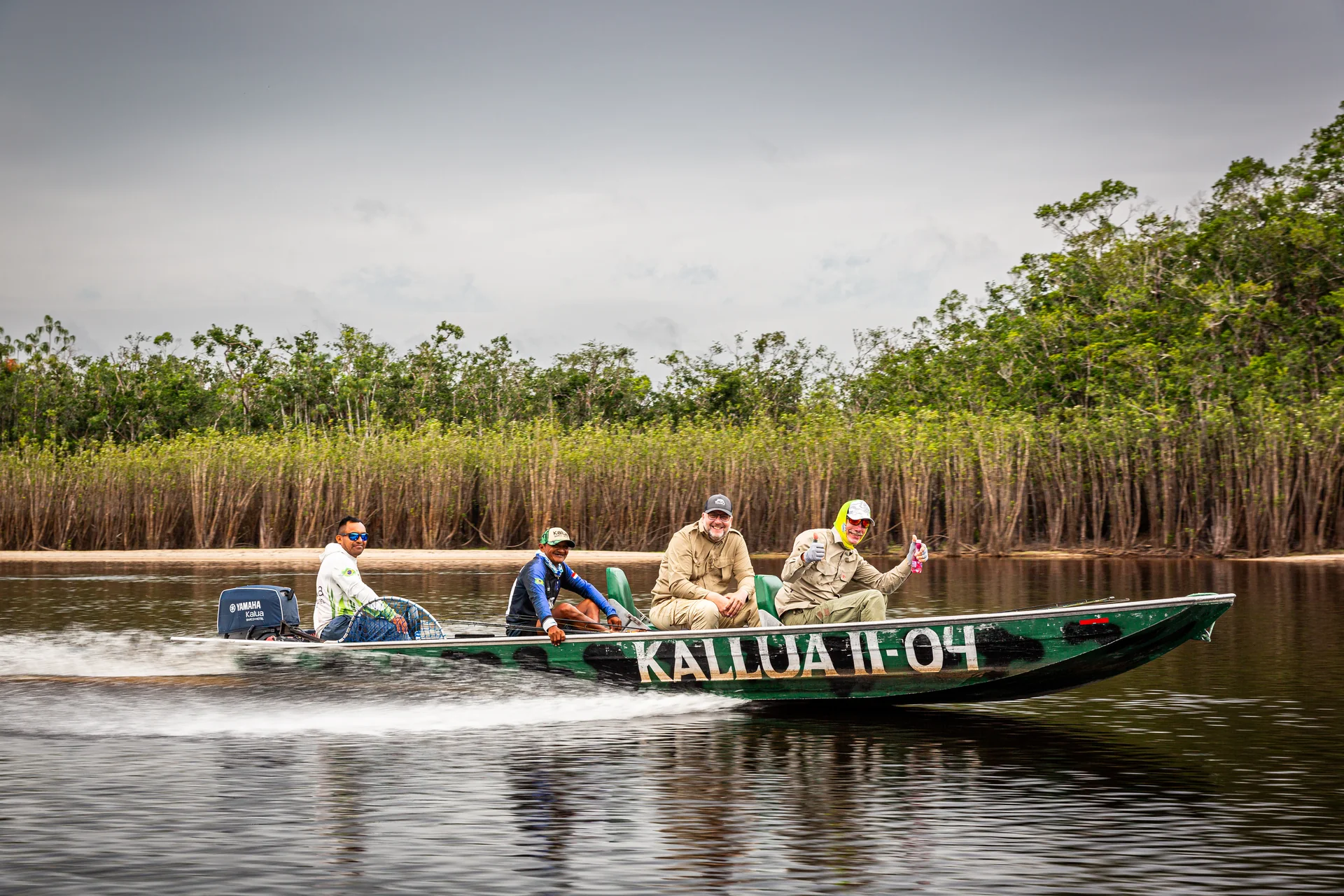
- Never more than 2 anglers and one experienced local guide per boat
- Comfortable mothership with air-conditioned cabins, private bathrooms and Starlink internet in the middle of the jungle
- A river full of side arms, lagoons and bays that open up a new fishery every single day
WHAT AWAITS YOU ON YOUR AMAZON FISHING HOLIDAY
This is how your fishing adventure begins:
From Europe you fly via Frankfurt to São Paulo and on to Manaus, the capital of the Brazilian state of Amazonas. Here we schedule a stopover – to arrive properly and, quite pragmatically, to give delayed luggage a chance to catch up. If you want to acclimatise at your leisure, you can easily add two or three days beforehand; we are happy to organise that for you.
This time in Manaus is anything but wasted. The city in the middle of the rainforest offers genuine sights with its legendary opera house, the great market and the meeting of the waters of the Rio Negro and Rio Solimões. Above all, though, this is where you find the tackle shops in which to stock up on exactly the lures you cannot get in Europe – and in which our groups, in our experience, spend considerably more time than planned.
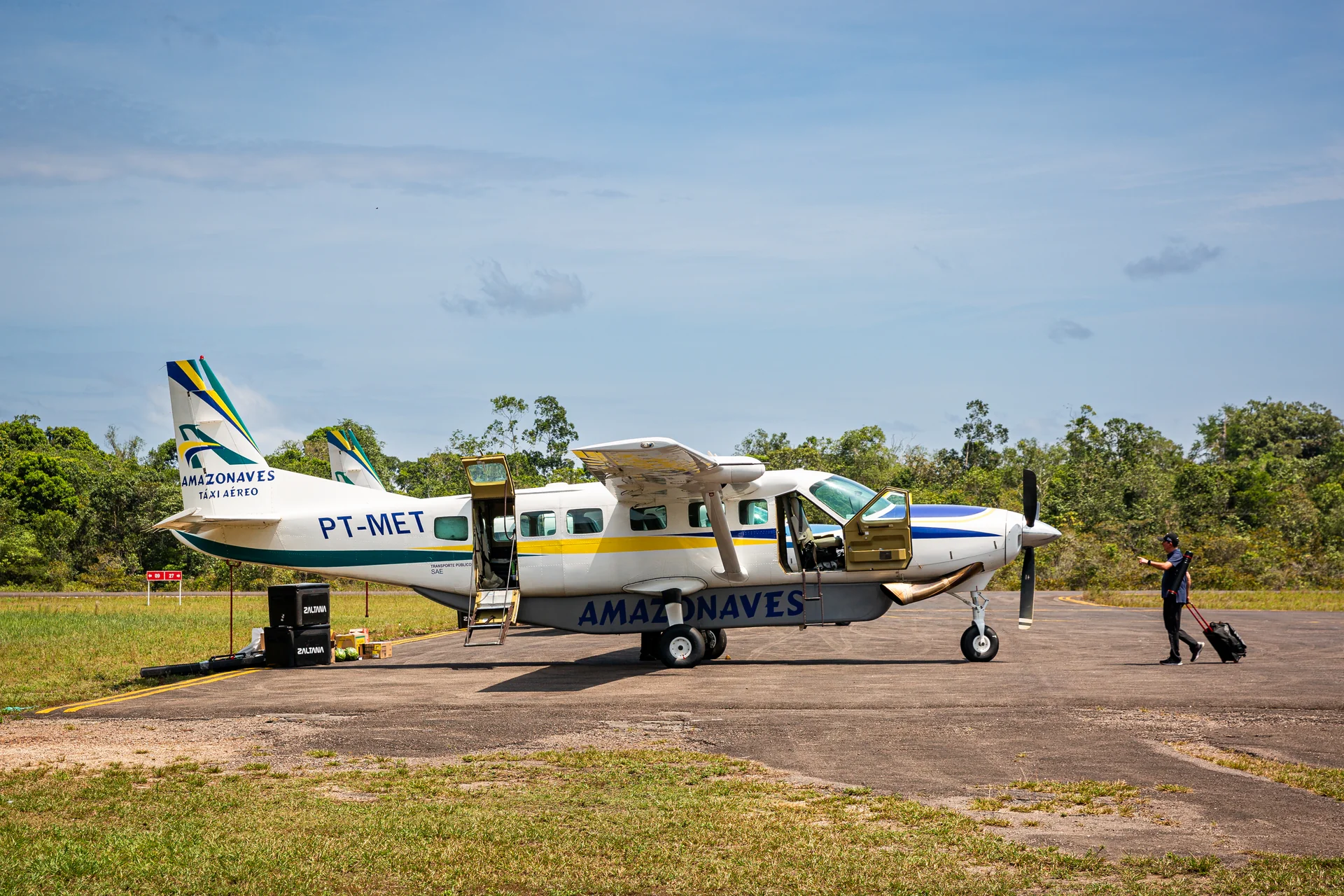
Then you move on: a small propeller aircraft takes you from Manaus to Santa Isabel do Rio Negro, a remote town deep in the interior. On the approach you can already see below you the maze of side arms and oxbow lakes you will be fishing in the days to come. After a short transfer you board your floating home for the week ahead. The run into the Jurubaxi takes around three hours – enough time to rig your tackle in peace and get into the mood. You make your first casts that afternoon.
YOUR FIRST DAY OF FISHING ON THE RIO JURUBAXI
The first afternoon is often the toughest of the whole week – and that is normal. You have to cast yourself in, learn to read the water, get a feel for the rhythm of the prop bait. You work the lagoons methodically, cast as tight as possible to the deadwood lying in the water, and wait for the moment the surface bursts open.
On our October 2024 tour, one of our participants in the neighbouring boat caught a peacock of over 70 centimetres with his very first cast. For us, on the other hand, it took until late afternoon before a brutal strike came – and then, of all things, the gearbox of the multiplier reel gave out. The guide even tried to take up the line by hand, but the fish was gone. “GRANDE!” – that was all he said, and all he needed to say. It is exactly for fish like that you travel to the Jurubaxi.
Back at the mothership, a rich dinner awaits, the first stories are exchanged, and thanks to Starlink on board, the connection home is better than in many a village in Germany. The next morning you are back on the river shortly before six – and the second day has an astonishing tendency to make you forget the first.
YOUR TARGET FISH: THE PEACOCK BASS
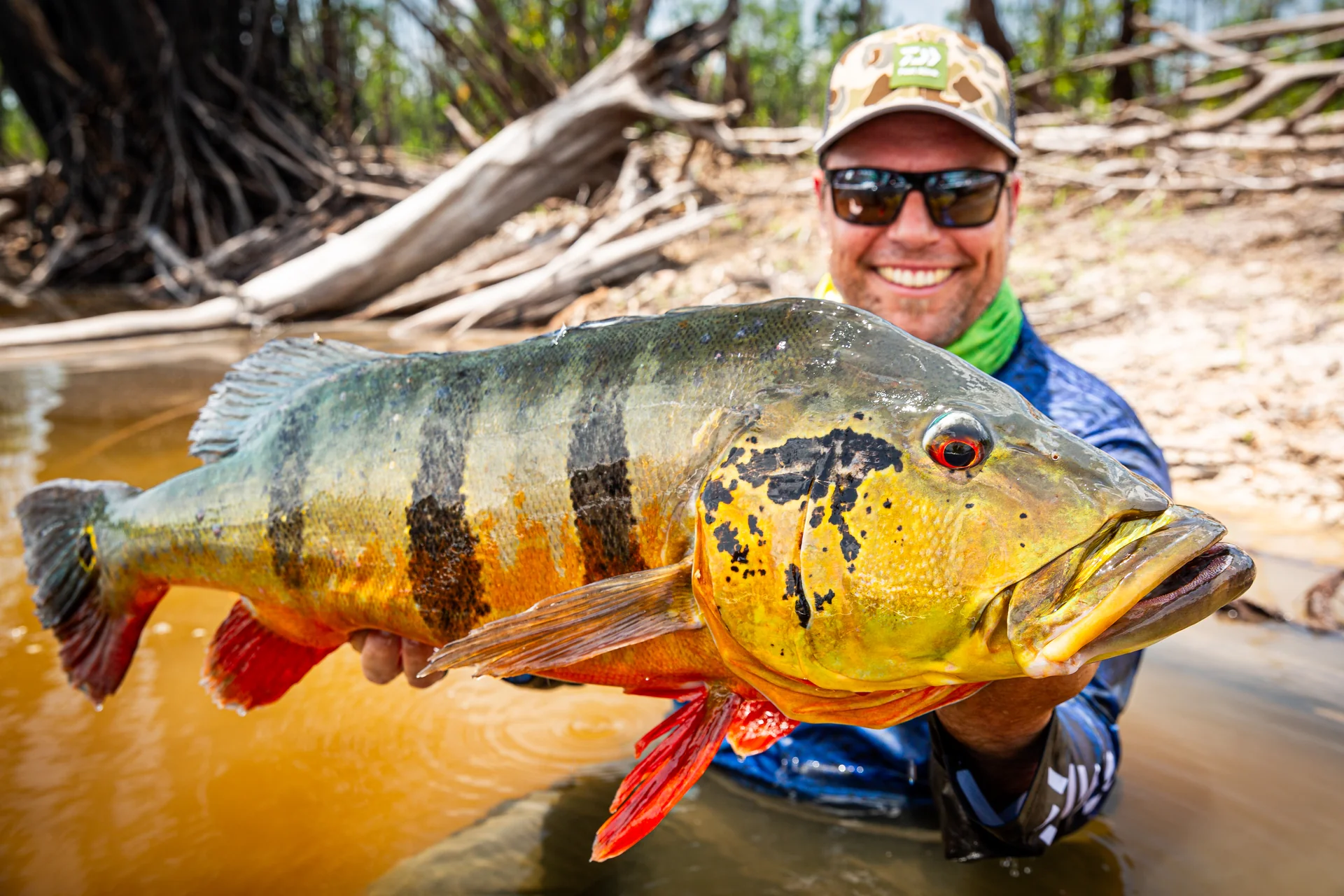
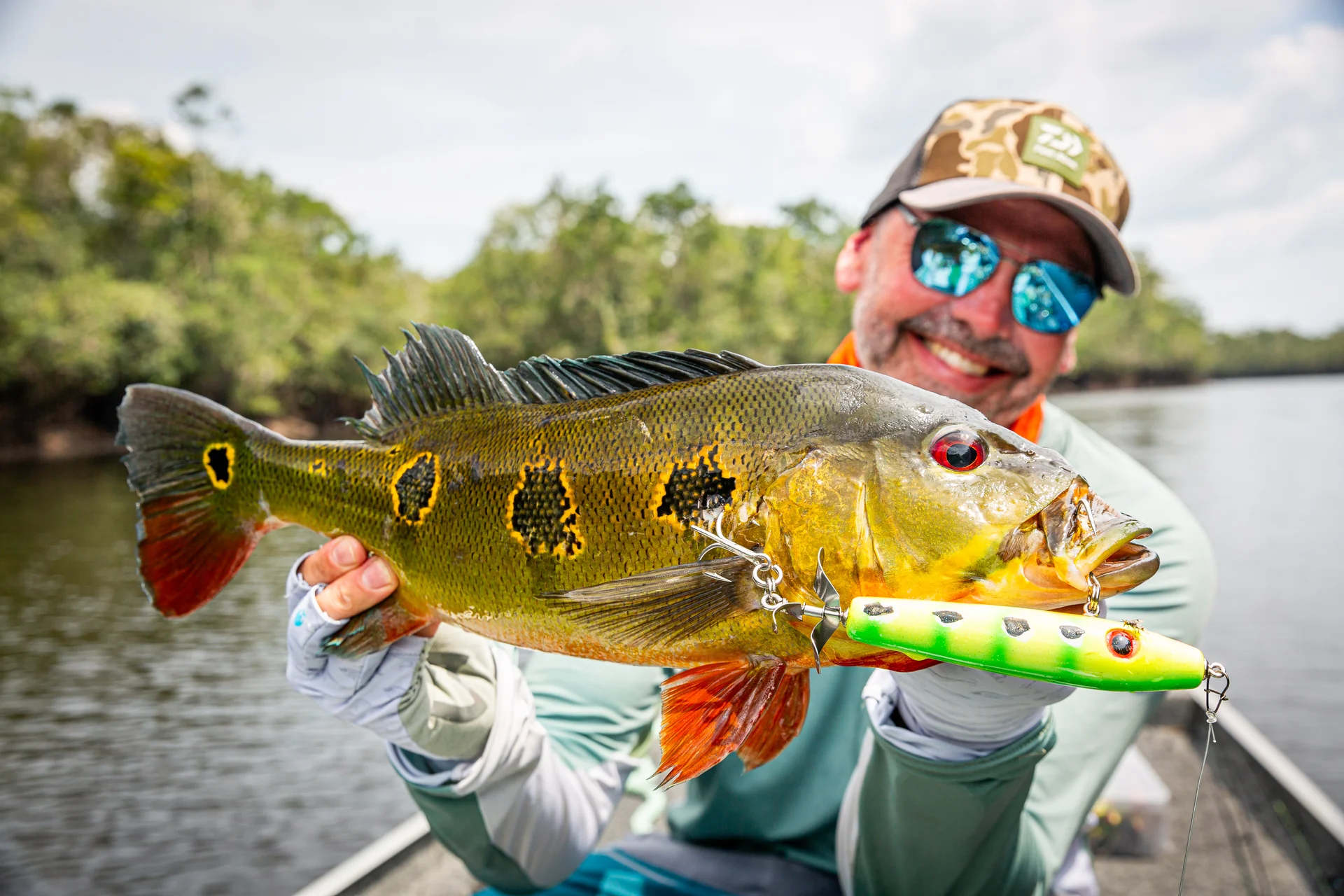
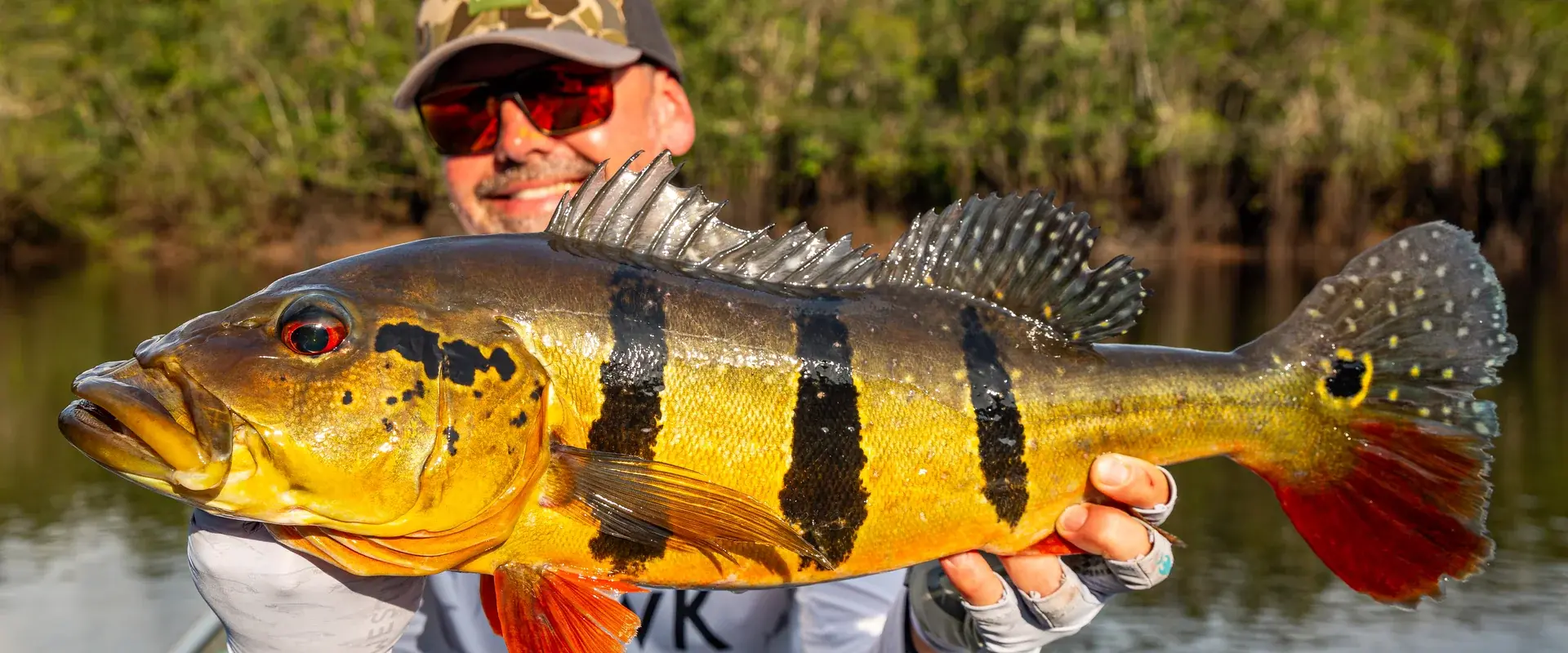
There are more than 15 described species of peacock bass of the genus Cichla in South America. The largest and mightiest of them is Cichla temensis – and that is exactly the one found throughout the drainage of the Rio Negro. These fish can reach weights of around 30 pounds; according to reports from river residents, the 15-kilo mark is even exceeded in rare cases.
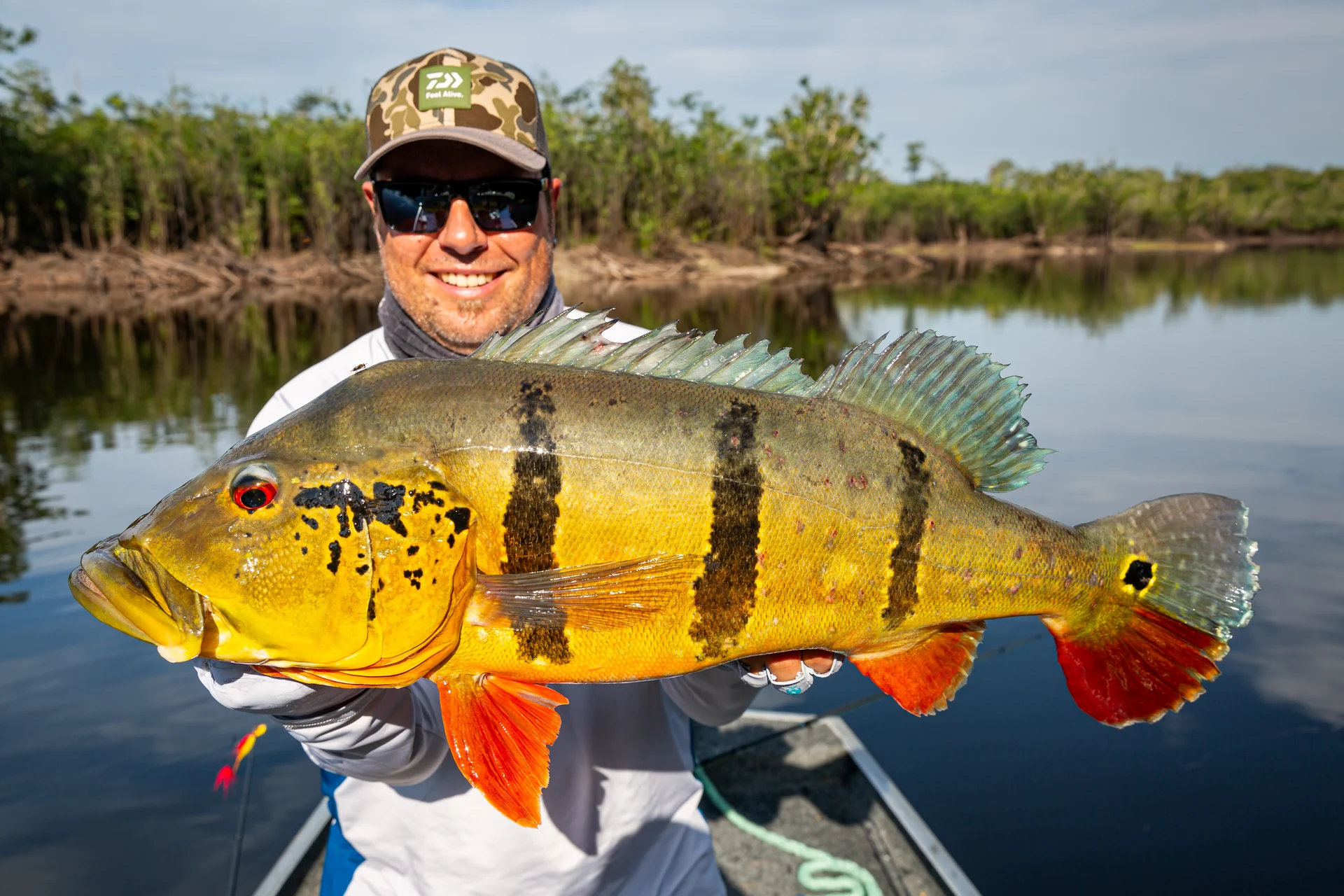
Two colour phases, one fish. The temensis has two completely different appearances. Outside the spawning season it wears the speckled dress known in Brazil as “paca”. At spawning time it changes into the “açu” colouration, also called “three bar”, with three striking vertical black stripes. The transition between the two phases is gradual and produces some of the most astonishing colour variants an angler can ever see on a fish.
Habitat. The peacock bass is decidedly territorial. Its preferred territories are lakes and lagoons, riverbanks and bays connected to the river by wide mouths, plus oxbow arms and shallow areas with plenty of structure and sandbanks – precisely the water forms that define the Jurubaxi.
Feeding behaviour. Peacock bass hunt other fish and are anything but picky about it – up to and including their own kind. In their youth, shrimps, insects and other arthropods are also on the menu.
Reproduction. Spawning takes place year-round, but the focus lies between the dry season and the onset of the rainy season. The fish dig nests on the bottom of riverbanks or on sandbanks and guard their brood for weeks in the same area. If a predator – or a fishing lure – approaches during this phase, their behaviour becomes extremely aggressive. For us anglers, this defensive behaviour is precisely the key to the fascination of this fishery.
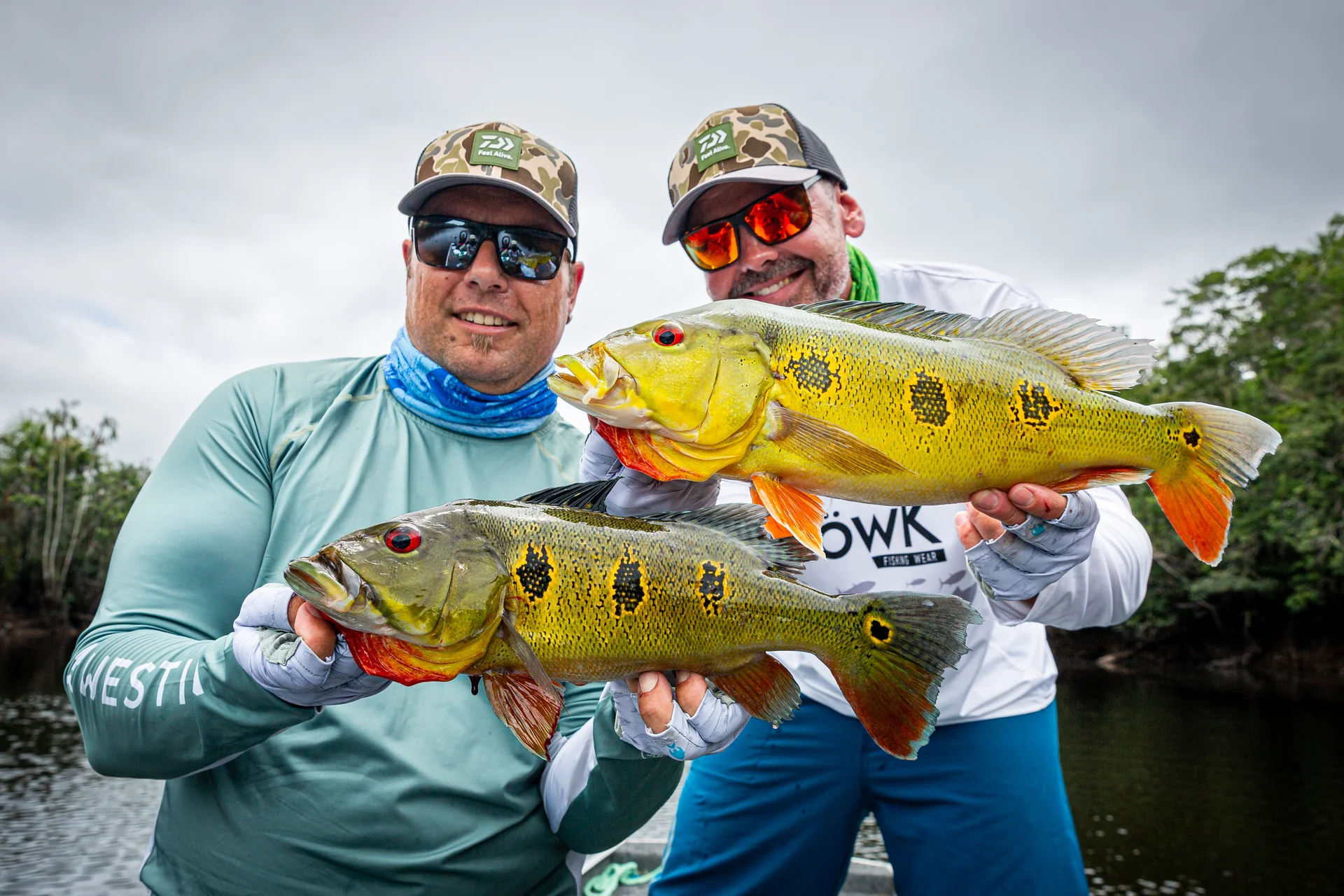
The little brother: butterfly peacock. While hunting the big temensis, you will inevitably catch numerous smaller peacocks that guides and locals call butterfly peacock. Scientifically, this is Cichla orinocensis, a large South American cichlid from the drainages of the Rio Negro, the lower Rio Branco and the Orinoco. Its hallmark is three large, irregularly shaped eye spots ringed in yellow or gold along the flanks. What they lack in size, they make up for in aggression: even fish of 40 centimetres will attack a 15-centimetre lure without hesitation.
TYPICAL ITINERARY OF YOUR FISHING TRIP TO THE RIO JURUBAXI:
Day 1: Departure from Europe
Day 2: Arrival in Manaus, transfer to the hotel, overnight stay
Day 3: Domestic flight to Santa Isabel do Rio Negro, transfer to the mothership, approx. 3-hour run into the Jurubaxi, first afternoon of fishing
Days 4–8: 5 full days of fishing from approx. 6:00 a.m. until late afternoon
Day 9: Half day of fishing in the morning, lunch on board, then the return run – overnight on board or at the hotel in Santa Isabel
Day 10: Morning flight back to Manaus, overnight at the hotel
Day 11: Return flight to Europe Day 12: Arrival back home
Optional: If you want to acclimatise in Manaus beforehand, add two or three extra nights – time for the opera house, the market, the meeting of the waters of the Rio Negro and Rio Solimões and, of course, the tackle shop.
Important for planning: A very tight luggage limit of 18 kg checked and 5 kg hand luggage applies on the domestic flight to Santa Isabel. We will send you a packing list in good time before the trip, which in our experience makes it work out fine. In addition, our partner on site offers a laundry service, which is why you should pack one more lure instead of too much clothing.
THE RIGHT TACKLE FOR THE RIO JURUBAXI
On the Jurubaxi, the fishing is heavier than on the Rio Negro – the target size is different, and the fish has to be kept away from the nearest tree. So gear up a class stronger than you are used to from bass or pike fishing at home.
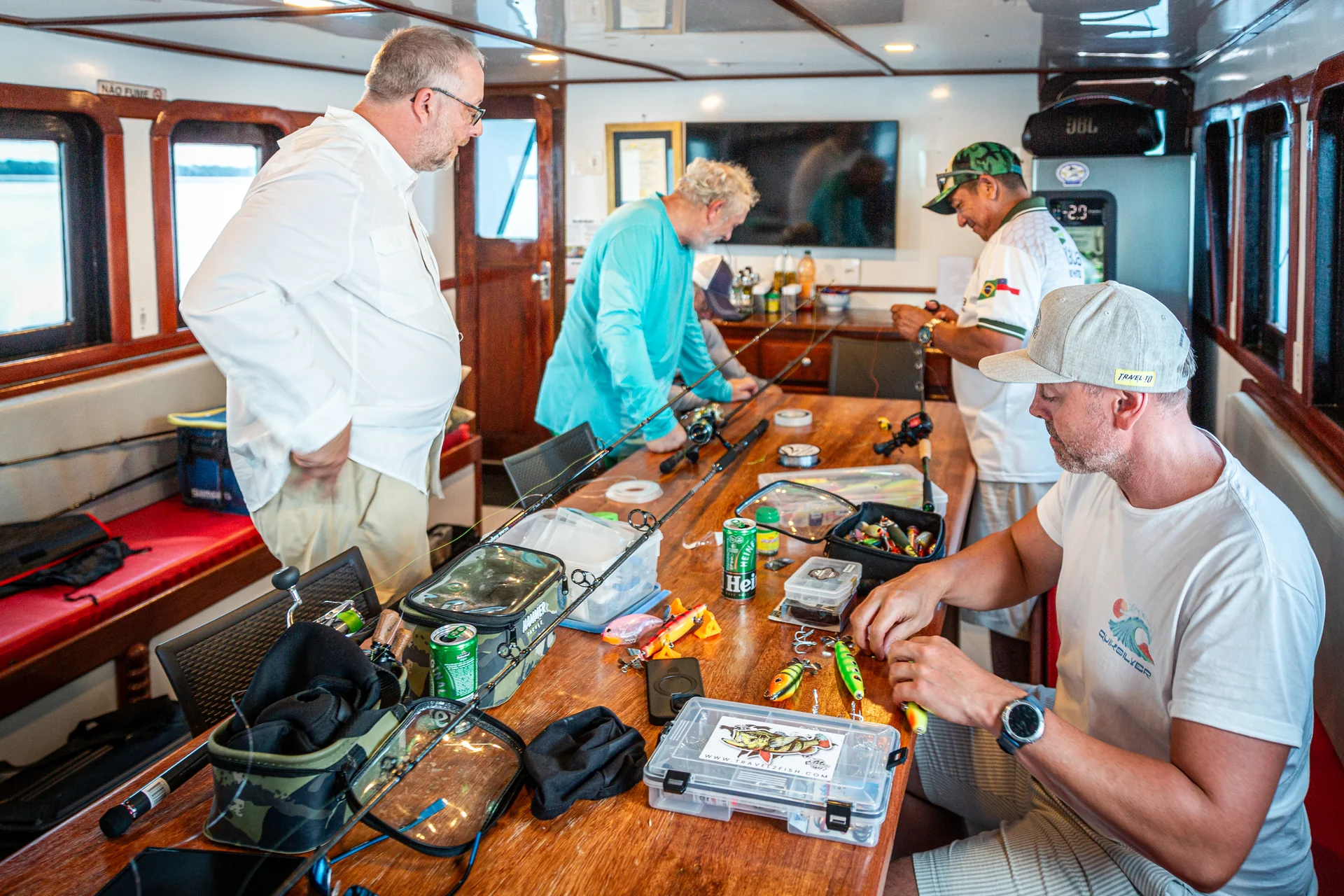
For fishing with prop baits and large surface lures we recommend a powerful baitcasting rod with a casting weight of up to about 150 grams, combined with a robust multiplier reel with a high gear ratio and a braided main line of at least 50 lb. For jerkbait and feather jig fishing, a somewhat lighter combination in the class of a heavy pike or jerkbait rod with a 100 to 200 size multiplier works well.
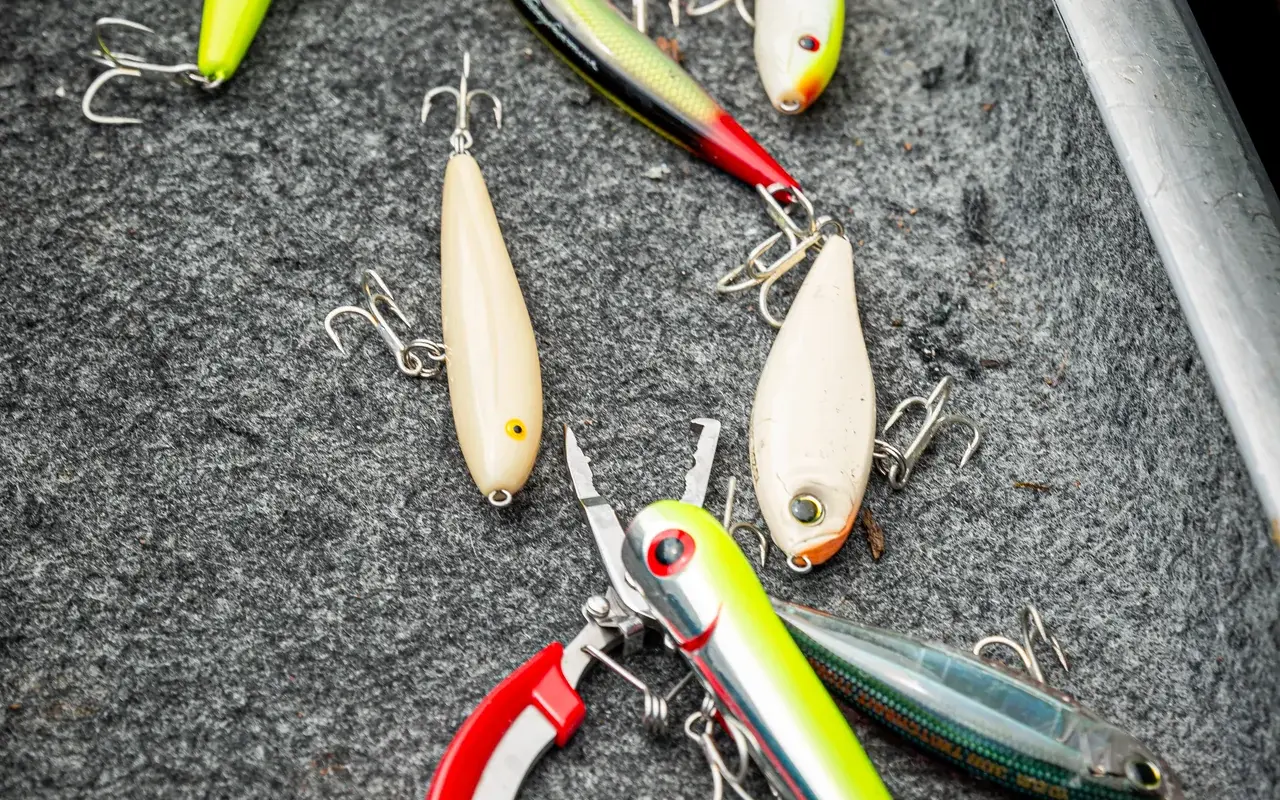
As for lures, a clear picture has emerged over recent years. The biggest fish come to us almost without exception on prop baits – the High Roller models are expensive and made of wood, but they deliver. Stickbaits such as the Rebel Jumping Minnow, Nelson Nakamura Sara Sara, Mahi Pen or Bonnie provide frequency and good fish as well. The Nelson Nakamura Zap 120, a cross between stickbait and popper, has also proven itself. You should definitely bring feather jigs – one of the biggest fish of our last tour came on a hand-tied jig in pink and white. Loud rattle baits like the Bill Lewis Supertrap can also make the difference on certain days.
As for colours, white and black work most reliably in the dark water of the Rio Negro. And a practical note: many of these lures are hard or impossible to get in Europe. So plan time for the tackle shop in Manaus – our groups traditionally stock up extensively there.
In preparation for the tour, you will receive detailed tour information from us, including our personal lure and tackle recommendations.
INTERESTING FACTS ABOUT THE RIO JURUBAXI AND THE AMAZON
- The Rio Negro is the largest blackwater river on earth. It rises in Colombia and flows into the Amazon at Manaus.
- It owes its dark yet clear colouration to the high content of humic and fulvic acids from the rainforest.
- The Rio Jurubaxi is a tributary of the Rio Negro and lies on its middle course on the indigenous land of Téa-Jurubaxi, which was recognised by the Brazilian government in September 2017.
- In 2018, a tender process determined who may fish this tributary exclusively – the choice fell on our partner with the ships Kalua I and II.
- Sport fishing is permitted on the Jurubaxi only around twelve weeks a year, from late August to December.
- A comparable exclusive project exists only around 200 kilometres away on the Rio Marie, which, however, is reserved exclusively for fly fishers.
- The river record of the Jurubaxi stands at 90 centimetres in length and 27 lb in weight.
- Thanks to the low pH of the blackwater, there are practically no mosquitoes on the Rio Negro and its tributaries in the dry season – many of our guests barely see a single one all week.
- The Amazon rainforests are home to more than 40,000 plant species, over 400 mammal species, almost 1,300 bird species and more than 3,000 fish species.
- The Brazilian real is the official currency. In Manaus, US dollars are usually accepted as well.
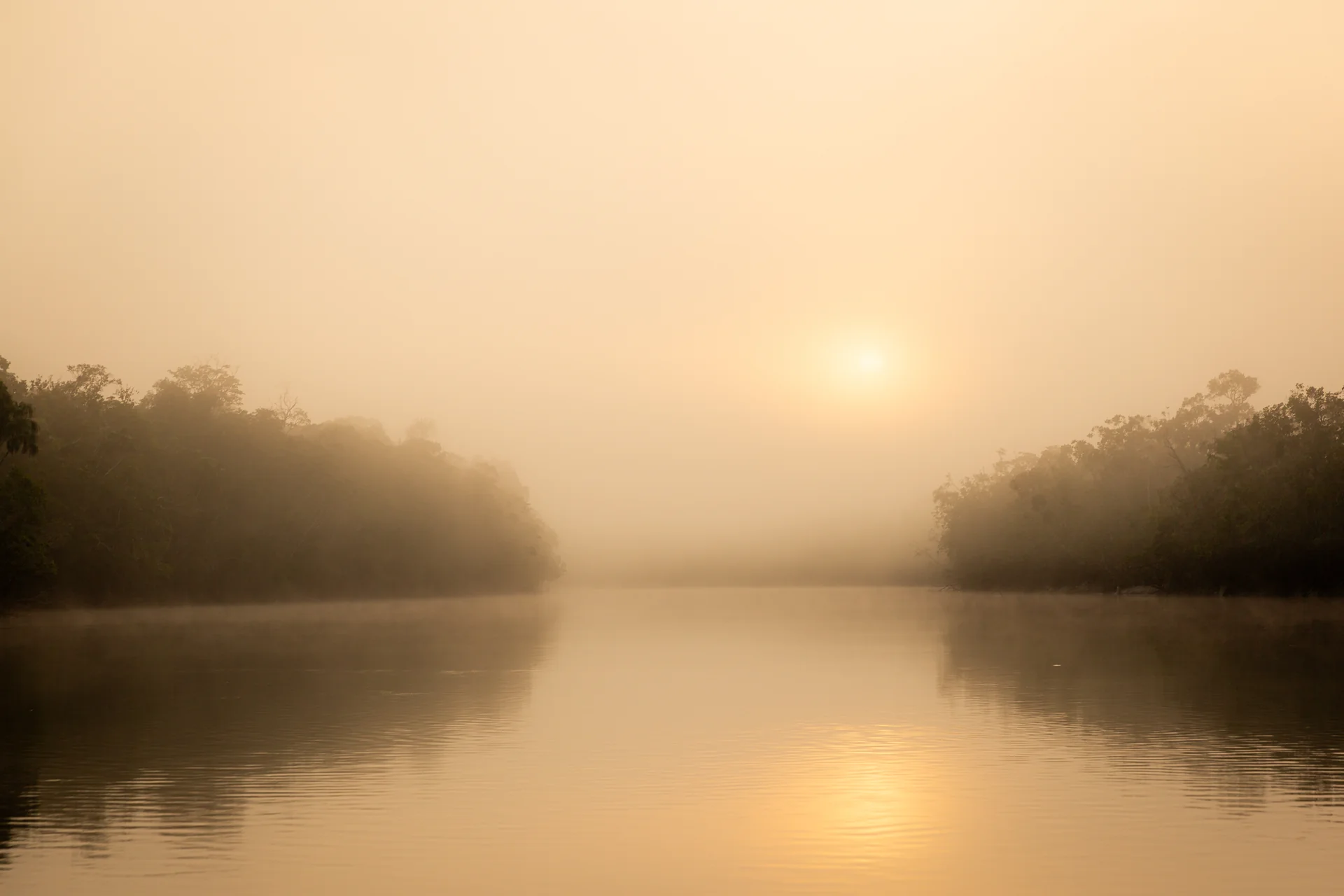
YOUR FLOATING ACCOMMODATION ON THE JURUBAXI
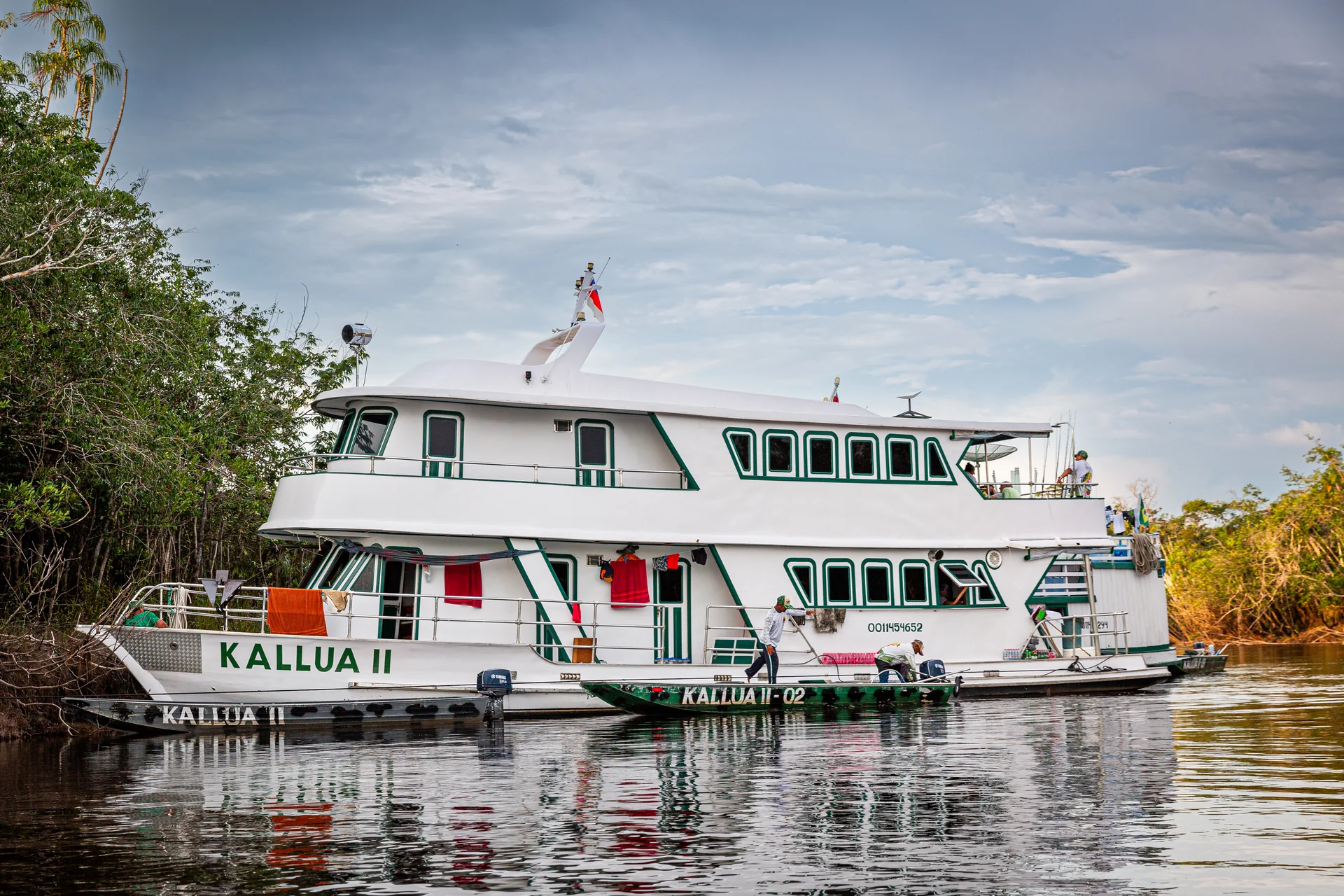
Your home for the week is the mothership Kalua I – the smaller of our partner’s two ships and, with a capacity of no more than 10 anglers, the reason there is so little pressure on the water of the Jurubaxi.
On board you will find air-conditioned cabins with private WC and shower, a spacious dining area with a bar, and a crew that has had the operation down to a fine art for years. Cabins are occupied by two people each – single cabins are not available on board. You enjoy breakfast and dinner on the ship; food and drinks for the day are carried on the fishing boats. And yes: thanks to Starlink you have a better internet connection in the middle of the Amazon than in many places at home – if you want a digital detox, you will have to actively opt for it.
While you fish during the day, the mothership relocates and picks you up in a different spot in the evening. That way you fish a new section of the river every day.
THE BEST TIME FOR YOUR FISHING TRIP TO THE RIO JURUBAXI
The question of the best time to travel almost answers itself on the Jurubaxi: sport fishing is only permitted here for around twelve weeks a year, from late August to December. Within this window, the water level is the decisive factor – on falling and low water, the fish concentrate in the lagoons and oxbow arms, which makes the fishing more predictable.
The climate in the Amazon rainforest is tropical, with temperatures of around 28 to 35 degrees. Short rain showers are possible all year round and are usually a welcome cool-down rather than a nuisance. Insects – contrary to what many expect – are hardly an issue: the low pH of the blackwater means mosquitoes practically do not occur here. Mosquito-proof clothing and tropical repellents do no harm, but as a rule they stay in the suitcase.
Because only a few weeks are available per season and we can secure only a limited number of them for our guests, the places are allocated early. As a rule, we plan the tours more than 1.5 years in advance. If you want to join a tour, you should not wait too long to decide – we will gladly tell you about current dates and available places on request.
WHAT DOES YOUR FISHING TRIP TO THE RIO JURUBAXI COST?
Price: from EUR 5,500 (international flights not included)
Included in the price:
- Domestic flights Manaus ↔ Santa Isabel do Rio Negro
- 6 days of guided fishing (2 anglers per boat + guide)
- 6 nights on board the Kalua (2 people per cabin, private bathroom with shower and WC)
- All meals, snacks and drinks (incl. alcohol) on board
- Drinks and food during the fishing days
- 2 hotel nights in a shared double room in Manaus
- German- or English-speaking tour hosting
- Daily laundry service (travelling light is possible)
- All transfers on site
Not included in the price:
- International flights to Manaus (price varies depending on departure airport)
- Meals at the hotel in Manaus
- Single room for the nights in Manaus
- Visa and entry formalities
- Travel insurance
- Fishing tackle and lures
- Tips for the boat crew (approx. USD 150 per angler)
- Personal expenses
BOOK YOUR FISHING TRIP TO THE RIO JURUBAXI NOW
The Jurubaxi is not a trip for everyone. If you are after numbers, you are better off on our Rio Negro tour – there, up to 50 peacocks are possible on good days. But if you are prepared to work with focus for a whole week for one single fish, if you love the sudden, brutal strikes, want the blistering runs and wish to experience a water that nobody but a handful of anglers fishes each year: for you, there is hardly a better address in all of South America.
Get in touch for a quote for your personal meeting with the king of the jungle.
Your Travel2Fish team
INQUIRY